Virtual Conferencing
Conquering lighting, reflections and angles of our computers and making them compatible with our existing glasses.

There is something quietly poetic about the eye’s inner architecture—delicate, translucent, and ever so subtly evolving with time. Among its most intriguing components lies the vitreous body, a gel-like substance that fills the space between lens and retina. In myopic eyes, however, this seemingly serene structure often follows a more complicated narrative.
Myopia, or nearsightedness, does not merely influence how one sees the world—it reshapes the eye itself. As axial length increases, the vitreous chamber expands, and with it comes a predisposition to earlier and more pronounced vitreous changes. But where does natural aging end and risk begin?
With age, the vitreous undergoes a process known as syneresis—a gradual liquefaction paired with the collapse of its collagen framework. In emmetropic (non-myopic) eyes, this transformation tends to unfold gently over decades. Floaters may appear like fleeting whispers across one’s vision, and posterior vitreous detachment (PVD) often emerges as a benign rite of passage in later adulthood.
In myopic individuals, however, this timeline is accelerated. The vitreous may begin to liquefy earlier, its structural integrity compromised not only by time but by the elongated geometry of the eye itself. Thus, what is typically an age-associated phenomenon may arrive prematurely, subtly shifting the clinical landscape.
Yet aging alone does not tell the whole story. Certain risk factors amplify vitreous changes in myopia, transforming a quiet evolution into a matter requiring vigilance.
High myopia, in particular, introduces a heightened vulnerability. The stretched retina and thinned sclera create an environment where vitreoretinal adhesions become more precarious. As the vitreous liquefies and shifts, traction may occur—sometimes leading to retinal tears or detachment.
Other contributing factors include ocular trauma, prior intraocular surgery, and systemic conditions that affect connective tissue integrity. Even lifestyle elements—such as prolonged near work or digital eye strain—may indirectly influence vitreous behavior, though the evidence remains elegantly nuanced.
Distinguishing between age-related vitreous changes and those driven by risk factors is less about drawing a rigid line and more about cultivating clinical intuition. Symptoms such as a sudden increase in floaters, flashes of light, or a shadow in peripheral vision should never be dismissed as mere inconveniences. In myopic patients, they may signal something more consequential.
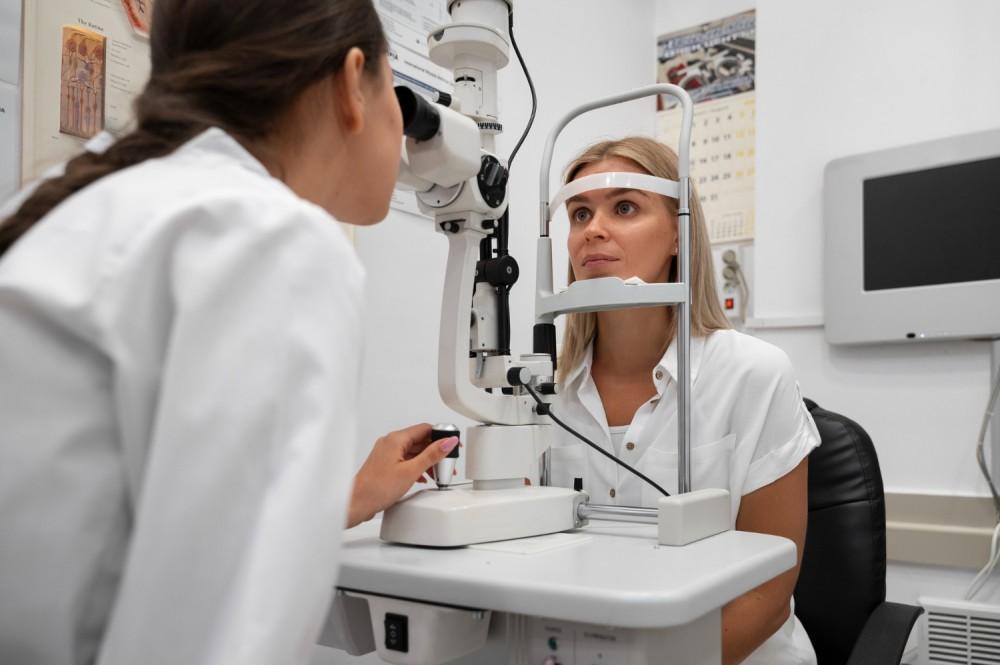
Routine comprehensive eye examinations become, therefore, not just advisable but essential. Through careful evaluation, optometrists can monitor vitreous integrity, assess retinal health, and intervene when necessary—often before symptoms escalate.
In the end, the vitreous serves as both a mirror and a messenger. It reflects the passage of time while quietly communicating the eye’s structural story. For those with myopia, this story may carry a few more plot twists—but with attentive care, it remains one that can be navigated with clarity and confidence.
At OC Optometry Group, we believe in approaching these changes not with alarm, but with informed elegance—guiding our patients through the subtle interplay of aging and risk with precision and care.
Contact our office in Irvine or Newport Beach at (949)-854-7122 or (949) 476-2870 to book an appointment.